


Why do burn marks appear on spring-loaded contacts even though the rated current was never exceeded?
The typical damage pattern
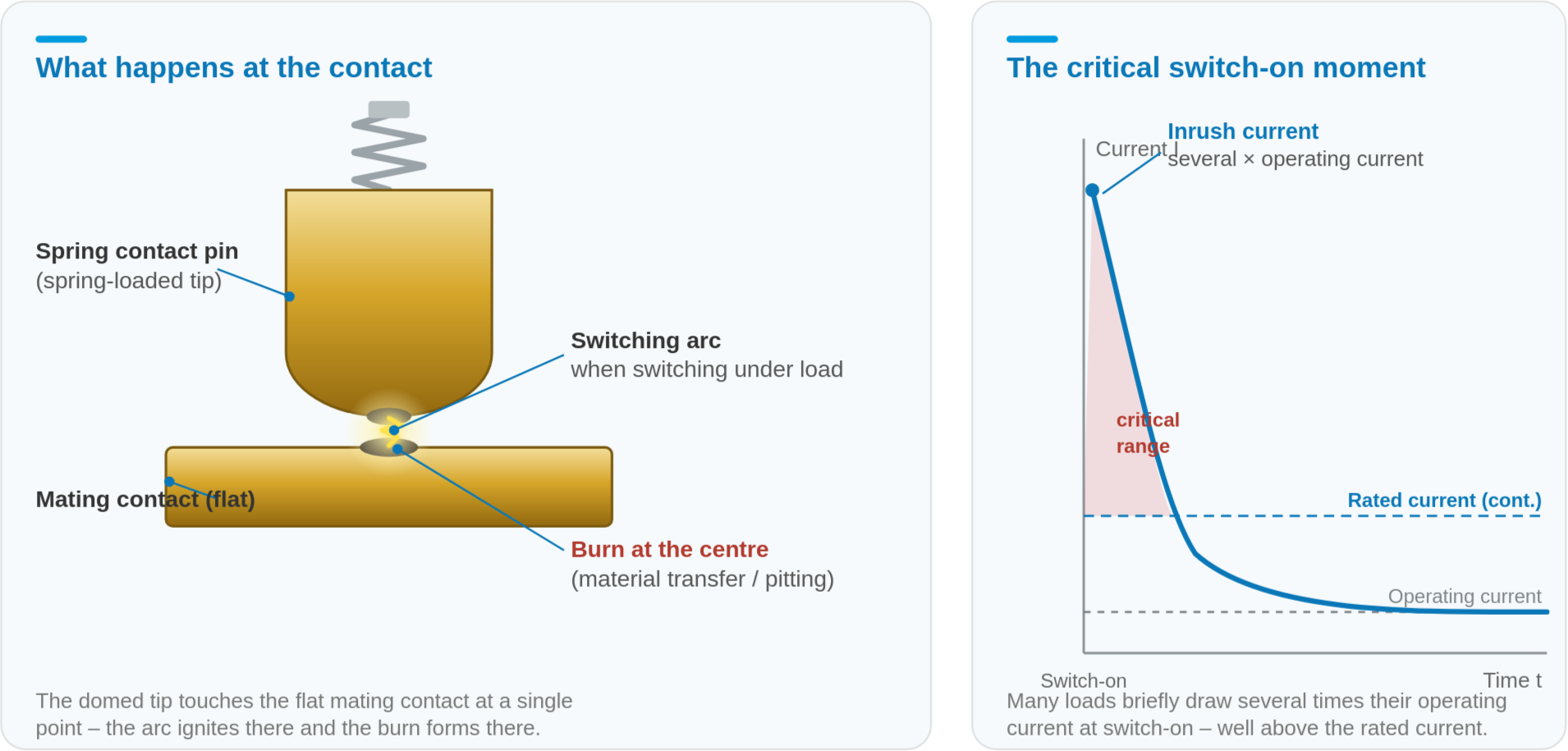
The burn usually shows up as a dark mark right at the centre of the contact area – both on the tip of the spring-loaded pin and in the middle of the flat mating contact. Alongside this, the contact resistance rises, and the marks can be neither wiped nor polished off.
The cause: a switching arc under load
A domed pin tip touches a flat mating contact at practically a single point in the centre. If the circuit is closed or broken in this state while current is flowing, a short arc forms at the first (or last) point of contact. It reaches very high local temperatures and transfers or vaporises material – exactly where the burn later becomes visible. The central position of the marks is the clear fingerprint of this mechanism.
The underestimated factor: inrush current
A frequently underestimated point is the current at the moment of switch-on. Many loads briefly draw a multiple of their operating current when connected, before the current settles to its steady-state value within a few milliseconds. Depending on the load type, this inrush current can reach several times up to more than ten times the operating current and thus lie well above the rated current of the contact. Typical causes are the charging of input capacitances (e.g. power supplies, drivers, filter capacitors), low cold resistances, or motor starting currents. Because the surge is very brief, it often goes undetected by standard current measurements – measured "peak values" therefore usually do not reflect the real inrush.
Why can't the burn be polished off?
Because it is not a loose deposit but altered base material: a re-melted and partly oxidised surface. The contact surface itself has changed and no longer conducts cleanly through metal-to-metal contact – hence the increased contact resistance.
Cycle rating: mechanical is not the same as electrical
The service life stated in datasheets usually refers to the mechanical actuation of the spring and assumes load-free ("cold") mating – i.e. the contact is closed mechanically first and current is applied only afterwards. When switching under load – and even more so with an inrush current – the electrical life is decoupled from this and is significantly lower, because here the limit is set by arc erosion rather than by the spring. The two figures are therefore not directly comparable.
How to avoid the burn
- Switch cold where possible: establish a secure mechanical contact first, then apply the current – and switch the current off before separating the contact.
- Limit the inrush current: e.g. with an NTC / inrush limiter or a soft-start, or switch the load via a separate switching element (relay/MOSFET) so that the contact only carries the operating current.
- Distribute the current or add margin: split the load across several contacts or use a higher-rated contact.
- Mind contact force and vibration: sufficient contact force and decoupling from vibration so that the contact does not briefly lift off under load.
Have a specific application in mind? We will select the right contact together with you.