




 Flexible heaters bring heat exactly where it is needed – across a surface, evenly, and in minimal installation space. uwe electronic develops and manufactures flexible heaters to customer specification: from the first sketch through the prototype to series production, with four carrier materials covering temperatures from –200 °C to +400 °C. For fast requirements we also keep standard types available.
What is a flexible heater?
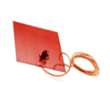
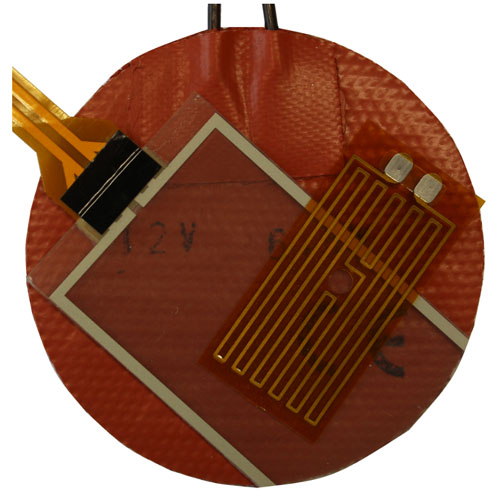
A flexible heater is a flat, flexible heating element: a resistance track, mostly produced by an etching process, is embedded between two layers of carrier material. This gives it its characteristic properties – very low profile, short heat-up times, homogeneous heat distribution and a long service life.
Because the heating track can be laid out freely, several temperature zones on a single heater are possible. A border area with higher power density, for example, compensates for heat losses at the edges so that the surface is evenly heated across its whole area.
Which carrier material suits your application?
The carrier material determines temperature range, profile height, power density and maximum size. Together, these four materials cover almost every application:
| Carrier material | Temperature range | Min. thickness | Max. power | Max. size |
|---|---|---|---|---|
| Mica | –150 to +400 °C | approx. 2.00 mm | 5 W/cm² | 1000 × 1000 mm |
| Kapton (polyimide) | –200 to +200 °C | approx. 0.10 mm | 4 W/cm² | 550 × 1000 mm |
| Silicone | –50 to +200 °C | approx. 0.80 mm | 4 W/cm² | 550 × 2000 mm |
| Polyester | –50 to +100 °C | approx. 0.25 mm | 1 W/cm² | 500 × 2000 mm |
In short: Kapton when it has to be thin yet withstand high temperatures. Silicone when flexibility and large areas are required. Mica for the highest temperatures. Polyester for cost-sensitive applications in the lower temperature range. Our carrier materials page compares all four in detail.
Where flexible heaters are used
A flexible heater almost always performs one of three tasks: it keeps an assembly at operating temperature, it prevents condensation and icing, or it brings a medium to a defined processing temperature. That makes for a very broad field of use:
- Medical and laboratory technology – temperature control of samples and media, condensation protection on analysis equipment
- Machine and plant engineering – preheated work tables and tools for reproducible process temperatures
- Laser and optical technology – preheating laser diodes to operating temperature
- Defence and security technology – warming equipment carriers so that gear is ready for use even in frost
- Rail and transport technology – snow- and condensation-free camera and sensor lenses, frost-free outdoor displays
- Food technology – constant processing temperature, for example in chocolate and mass processing plants
- Measurement and sensor technology – temperature control of sensitive sensors, protection against condensation and icing
- E-mobility – preheating batteries for reliable cold-start current
Our applications page shows how these are engineered in detail.
Your advantages at a glance
- Low weight and minimal space requirement
- Flexible, robust and reliable – also on moving or curved surfaces
- Almost any geometry and dimension can be realised
- Homogeneous energy distribution and consistent surface temperature
- Short heat-up time and low running costs
- Several temperature zones on a single heater
- Long service life and simple mounting
Temperature monitoring and control – already integrated
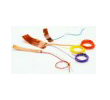
On request we integrate the complete temperature monitoring directly into the heater: temperature sensors such as PT100 or thermocouples, thermal fuses, thermal switches and temperature limiters, right through to miniature temperature controllers. You receive a ready-to-connect assembly rather than a set of individual parts – this saves assembly steps and removes sources of error at the interface between heater and control.
Quality and approvals
Our flexible heaters are manufactured in Germany under a consistent quality standard to ISO 9001. For safety-relevant applications, versions with VDE and UL approval are available; heaters from our production are in use in projects of the European Space Agency ESA, among others.
Standard or custom?
For many tasks a standard heater is sufficient: silicone or Kapton, round or rectangular, 12 V DC or 240 V AC, with self-adhesive film and available at short notice. As soon as geometry, power distribution, termination or integrated components differ from the standard, we engineer the heater together with you – from the drawing to series production.
Let's discuss your application
Send us your requirements – area, target temperature, supply voltage and installation situation are enough for a first assessment. Phone +49 89 4411900.


Specification subject to change without notice.