


Why does a spring-loaded contact lose spring force when it overheats – and the head gets stuck?
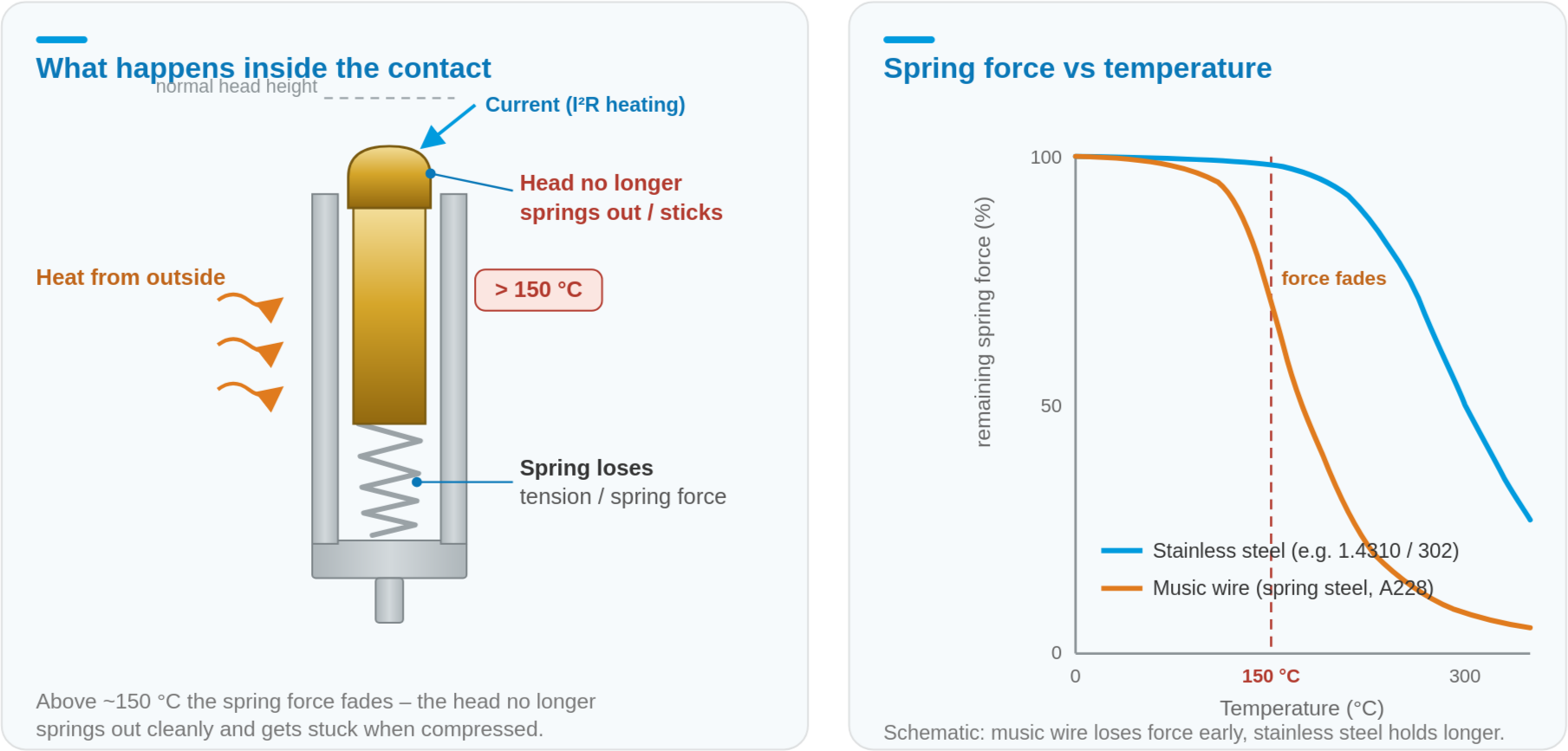
The typical damage pattern
Unlike arc or wear damage, the contact tip need not show any crater or wear ring here. The symptoms are mechanical and electrical: the head no longer springs out fully, feels "soft" or gets stuck when compressed, and the contact resistance is elevated or unstable. As an indication of the temperature reached, tempering colours (discolouration) may appear on the spring or barrel.
The cause: heat makes the spring relax
Inside the contact the spring is permanently preloaded. At elevated temperature a spring element under such load loses force over time – this effect is called stress relaxation. Part of it is reversible, but once the material limit is exceeded a permanent set remains: the spring shortens, the preload drops, and the return force is no longer sufficient. Both higher temperature and longer exposure increase the loss.
The spring material is decisive
| Spring material | Temperature behaviour (guide values) |
|---|---|
| Music wire / spring steel (ASTM A228) |
Very high strength, but limited heat resistance. Recommended continuous use only up to approx. 120 °C; above that – by 150 °C at the latest – the force fades rapidly. |
| Stainless spring wire (e.g. 1.4310 / AISI 302) |
Considerably more heat-resistant, usable roughly up to ~250 °C. Above about 150–200 °C it too loses force progressively, but much more slowly than music wire. |
| High-temperature materials (e.g. 17-7 PH, nickel alloys) |
For hot applications: they retain their spring force up to significantly higher temperatures. |
These figures are guide values and depend on time and load; the decisive figure is always the limit temperature stated in the datasheet of the specific contact.
Why does the head get stuck?
The return force of the weakened spring is no longer sufficient to overcome the friction in the guide gap – especially if that friction is already increased by abrasion or oxidation. Together with the permanent set, this means the head no longer returns reliably after being compressed.
How to avoid overheating and loss of force
- Lower the temperature: reduce current or current density, distribute the load across several contacts, and choose a low-resistance contact to reduce self-heating (I²R).
- Dissipate or shield heat: provide for heat removal and keep external heat sources away or shield against them.
- Select the contact for the real operating temperature: observe the limit temperature in the datasheet and derate the current capacity at high ambient temperatures.
- Choose the right spring material: stainless steel instead of music wire for warm environments, high-temperature materials (e.g. 17-7 PH or nickel alloys) for very hot applications.