


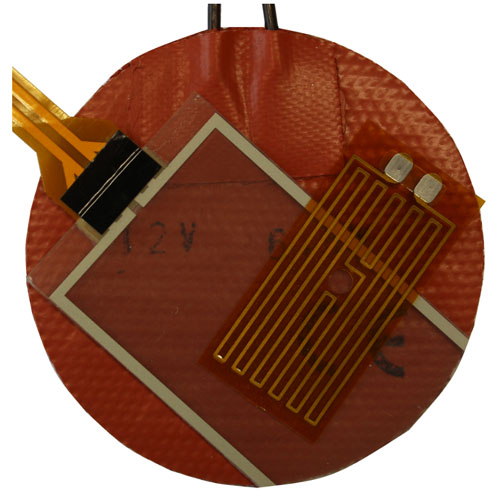
 The majority of our flexible heaters are built to customer specification. The reason is simple: as soon as a heater is integrated into an existing device, the design dictates the shape – not the other way round. This is precisely where the flexible heater is the right component, because its heating track can be laid out almost freely.
What we engineer for you
- Geometry and dimensions – from a simple rectangular heater to a contour with cut-outs and holes
- Power density and temperature zones – several zones on one heater, for example with a reinforced border area against heat losses
- Carrier material and type of insulation to suit temperature, installation space and ambient conditions
- Termination type and cable length
- Integrated temperature monitoring and control
Electrical terminations
Four termination variants are available, which we recommend depending on the installation situation and mechanical load:
- Lead wires, epoxy-potted – the most robust solution; the potting compound mechanically relieves the transition point
- Solder pads – if you wish to assemble yourself or connect directly to a PCB
- Connectors – for tool-free assembly and quick replacement in service
- Flexible conductor on a termination tab – when the termination has to be particularly low-profile
Integrated components
On request we integrate temperature monitoring directly into the heater: temperature sensors such as PT100 or thermocouples for measurement, thermal fuses and thermal switches to protect against over-temperature, and miniature temperature controllers for local control. You receive a ready-to-connect assembly instead of a collection of individual parts – this saves assembly steps and avoids errors at the interface between heater and control.
From enquiry to series production
- Enquiry – you describe the task, the installation space and the target temperature. A sketch or a photo of the installation situation is enough to start with.
- Design – we propose carrier material, power density, termination and monitoring, and agree the drawing with you.
- Samples – you receive prototypes for testing in the real assembly.
- Series – after your approval we manufacture in series, in Germany and to ISO 9001.
For custom versions, one-off tooling and set-up costs apply. We always show these separately in our quotation so that you can calculate unit costs cleanly.
What we need in order to quote
- Installation situation – drawing, sketch or photo of the surface to be heated, with dimensions
- Target temperature – required temperature and permissible tolerance
- Heat-up time – how quickly the target temperature must be reached
- Supply voltage – e.g. 12 V DC, 24 V DC or 230 V AC
- Ambient conditions – operating temperature, humidity, contact with media, mechanical load
- Monitoring and control – required sensors, fuses or controllers
- Quantity and schedule – annual demand and required delivery date