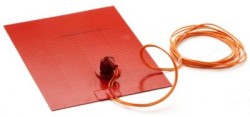


 Mounting determines whether a flexible heater transfers its power into the component at all. Trapped air acts like an insulating layer: at that point the heater heats into nothing, becomes considerably hotter locally than intended and may in extreme cases be damaged. A clean bond is therefore not a question of appearance but of function.
Applying heaters with self-adhesive film
Most of our flexible heaters are supplied with a self-adhesive film from the factory. Application works like any other adhesive film:
- Prepare the surface: the bonding area must be clean, dry and free of grease. Residues of oil, release agents or dust prevent a lasting bond.
- Peel the protective liner off the self-adhesive film – without touching the adhesive surface.
- Lay the heater down from one side and press it on progressively so that air can escape ahead of the bonding front. The aim is a full-area bond free of trapped air.
- Press down evenly afterwards. The adhesive only reaches its final strength after approximately 70 to 80 hours; during this period the heater should not be heated above 100 °C.
Why we recommend additional fastening despite the self-adhesive film
The self-adhesive film is a mounting aid and provides good thermal coupling – but we do not regard it as the sole permanent fastening. Under temperature cycling, at high surface temperatures or on difficult substrates, the adhesive bond may loosen over time. We therefore recommend as a matter of principle that the heater be additionally secured mechanically: with shrink or tension tape, by clamping, by vulcanising, or with an additional acrylic- or silicone-based adhesive. Which option is appropriate depends on the component – we are happy to advise.
No strain on cables, solder joints and components
The most common cause of field failures is not the heating track but the termination. Make sure that neither during installation nor in later operation any strain is placed on the connecting cables, the solder joints or the integrated components – that is, on temperature sensors, thermal switches and thermal fuses. Route the cables with a loop and fix them on the device side so that movement and vibration are not absorbed at the transition point to the heater. The same applies during installation: never pull on the cable to position the heater.
Mounting without self-adhesive film
Mica heaters can only be fastened mechanically – by pressing, clamping, tensioning or screwing. An organic adhesive film is not an option because it would volatilise above approximately +175 °C. For Kapton, silicone and polyester, shrink and tension tape, vulcanising and acrylic or silicone adhesives are available in addition to the self-adhesive film; thermally conductive adhesives are suitable where particularly good thermal coupling is required.
Limits and handling
- Maximum operating temperature: 100 °C for polyester, 200 °C for silicone – 175 °C with adhesive film
- Maximum surface pressure: 6 kg/cm²; point loads on the heating surface must be avoided
- Minimum bending radius: 1 to 8 mm depending on material
- Do not bond below an ambient temperature of 10 °C
- Do not use nitro-based solvents for cleaning
- Operate the heater only when bonded across its full area – exposed areas can overheat locally
We also provide the complete instructions for use with all processing notes as a PDF download.