


Why does the moving contact pin show a ring-shaped burn on its side (the sliding surface)?
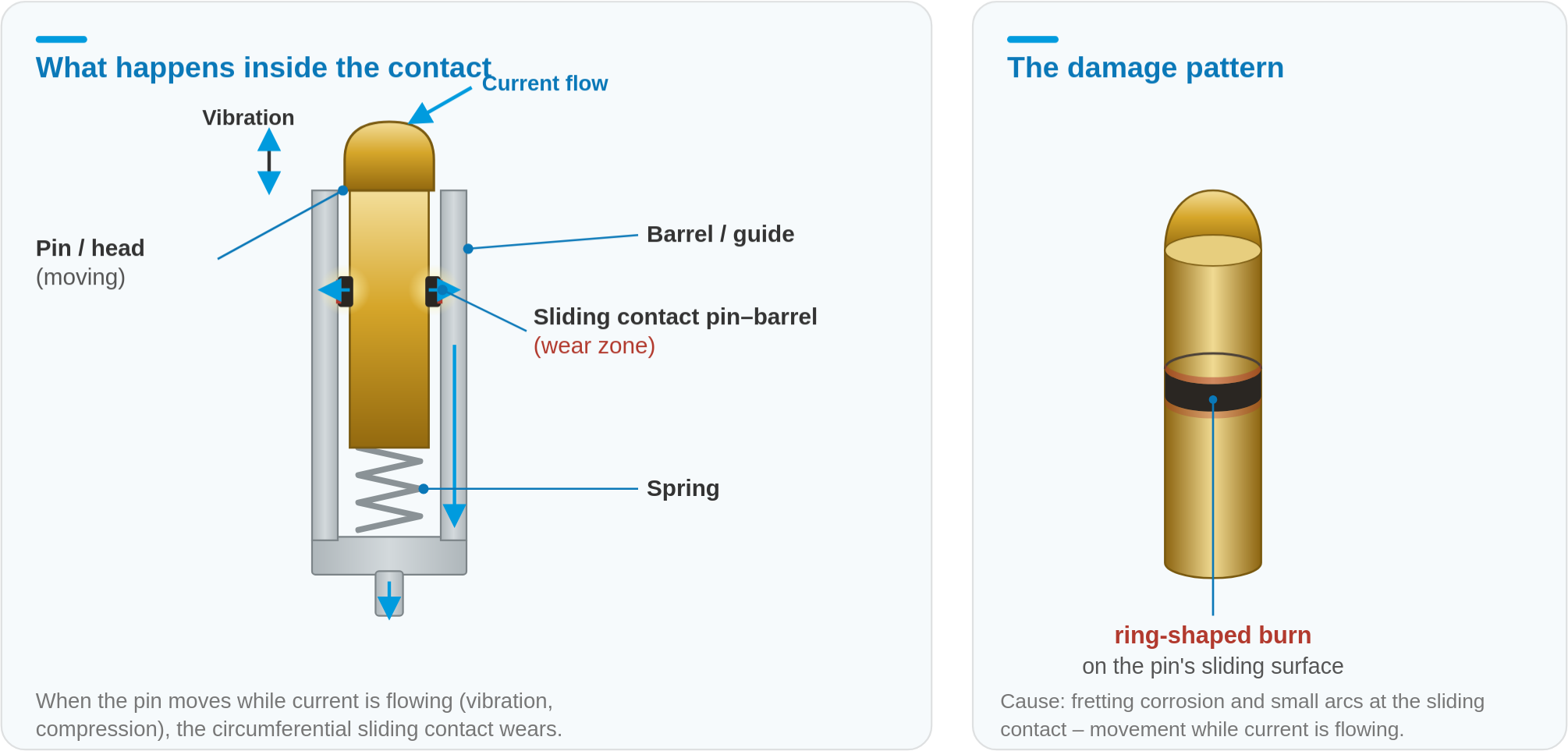
The typical damage pattern
The burn runs as a circumferential, ring-shaped dark band around the side of the moving pin – exactly where it slides inside the barrel or guide. Alongside this, the contact resistance rises, and fine dark debris or particles are often visible. The marks cannot be wiped or polished off.
The cause: movement under current at the sliding contact
In a spring-loaded contact the current flows across the contact zone between the moving pin and the barrel that guides it. If the pin is moved while current is flowing – due to vibration, shock or repeated compression – a continuous relative movement under load occurs at this circumferential contact zone. That is precisely what causes the wear. Because the pin touches the barrel all the way around, the damage spreads over the whole circumference – hence the ring-shaped appearance.
Two mechanisms act together
Fretting corrosion: the small, repeated sliding movements abrade the protective precious-metal plating and expose the less noble base material. This oxidises, and the resulting hard oxide particles act like an abrasive and increase the contact resistance.
Micro-arcing: if the pin lifts off even minimally due to the movement while current is flowing, tiny arcs ignite at the separation point. They melt and erode the surface locally – all the way around the contact circumference.
Why can't the burn be polished off?
Because it is not a loose deposit but altered base material: an abraded and oxidised or locally re-melted surface. It no longer conducts cleanly through metal-to-metal contact – hence the increased contact resistance.
How to avoid the burn
- Minimise relative movement under current: mechanical fixing or damping and avoidance of resonances, so that the contact does not move while current is flowing.
- Sufficient contact / spring force: a firmly seated pin prevents brief lift-off ("chatter") and thus the micro-arcs.
- Choose a contact suited to vibration and current: e.g. biased designs with a defined, stable current path, or designs with a robust/separate current path rather than only through the sliding contact.
- Distribute the current or add margin: split the load across several contacts or use a higher-rated contact.
- Suitable plating: harder or thicker surfaces improve resistance to sliding wear.